
Quick answer
A quinella is a bet on which two runners finish first and second, in either order. An exacta is the same bet, but your runners must finish in the exact order you pick. Because the exacta is harder to win, it usually pays more. A boxed bet covers more runners: a 3-runner boxed quinella is 3 combinations, and a 3-runner boxed exacta is 6. With flexi betting you choose your total outlay and get that percentage of the dividend.
What you'll learn
- What quinella and exacta mean, and how they differ
- Straight, boxed and standout bets, and how many combinations each needs
- How flexi percentages and dividends work, with worked examples
- What happens with scratchings and dead heats
- When a quinella or exacta makes sense, and when a win bet is better
Quinellas and exactas are the simplest exotic bets in Australian racing. Instead of backing one horse, you pick the first two past the post. They’re popular because a $1 or $2 bet can return far more than a win bet, without needing to find the first three like a trifecta. This guide explains how each one works, what it costs, and how the payout is calculated.
Quinella meaning: first two, any order
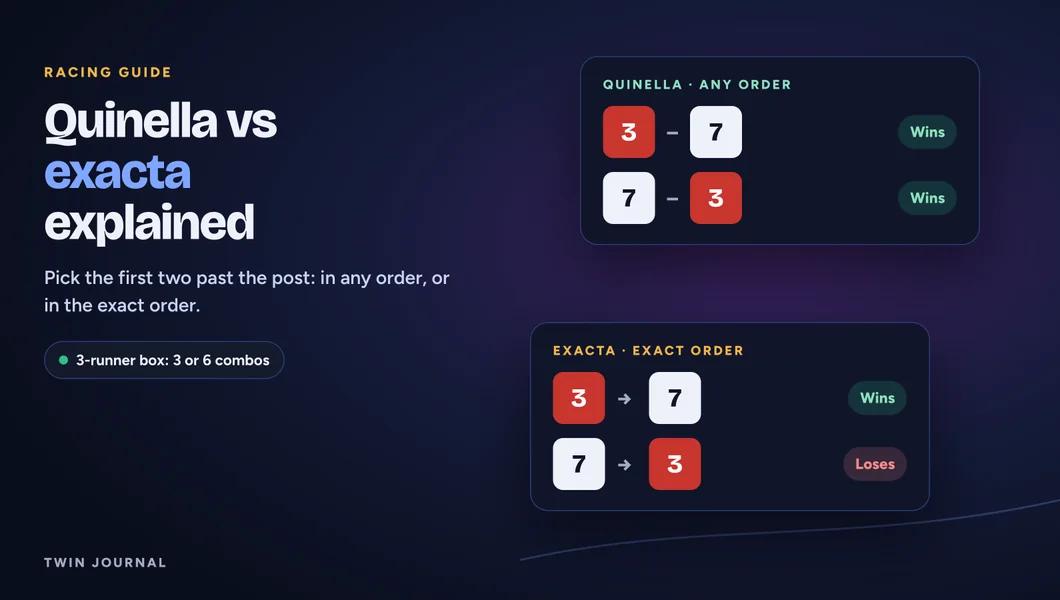
When you take a quinella, you pick two runners. If they finish first and second, you win, whichever of the two wins the race. If you pick runners 3 and 7, the result 3-7 and the result 7-3 both pay the same quinella dividend.
Exacta meaning: first two, exact order
An exacta also needs the first two runners, but in the order you pick. If you take 3 to win and 7 to run second, the bet pays only if the result is 3-7. If 7 wins and 3 runs second, the bet loses. Some people call it a “forecast”.
Quinella vs exacta at a glance
| Quinella | Exacta | |
|---|---|---|
| What you pick | The first two runners | The first two runners |
| Order matters? | No | Yes |
| Combinations for 2 runners | 1 | 1 straight, or 2 if boxed |
| Usual dividend | Lower | Higher, often about double the quinella for the same two runners |
| Best for | Two runners you think will fight out the finish | A strong view on which one will win |
A 2-runner boxed exacta covers both orders, so it costs twice as much as a straight exacta and wins in the same cases as a quinella. Whether that’s better than a quinella depends on the two dividends: the boxed exacta pays the exacta dividend on half your stake, the quinella pays the quinella dividend on all of it.
Boxed quinellas and exactas: how many combinations?
Boxing means choosing three or more runners and covering every pair. If any two of them finish first and second, you win. The cost rises quickly because each pair (or ordered pair, for an exacta) is a separate combination:
| Runners boxed | Quinella combinations | Exacta combinations | Cost at 100% (quinella / exacta) |
|---|---|---|---|
| 2 | 1 | 2 | $1 / $2 |
| 3 | 3 | 6 | $3 / $6 |
| 4 | 6 | 12 | $6 / $12 |
| 5 | 10 | 20 | $10 / $20 |
| 6 | 15 | 30 | $15 / $30 |
| 7 | 21 | 42 | $21 / $42 |
| 8 | 28 | 56 | $28 / $56 |
The formulas are simple. A boxed quinella with n runners has n × (n − 1) ÷ 2 combinations. A boxed exacta has n × (n − 1), exactly twice as many, because each pair can finish in two orders.
Standout bets: when you like one runner most
A standout puts one runner (or a few) in a fixed position and pairs it with others. It’s cheaper than a full box when you have a clear top pick.
| Bet | How it’s set up | Combinations |
|---|---|---|
| Standout exacta | Runner 4 to win, with 1, 6 and 9 to run second | 3 (4-1, 4-6, 4-9) |
| Standout exacta, two on top | Runners 4 and 6 to win, with 1, 9 and 11 to run second | 2 × 3 = 6 |
| Standout quinella (banker) | Runner 4 to finish 1st or 2nd, with any of 1, 6 or 9 | 3 |
| Reversed standout exacta | 1, 6 and 9 to win, with runner 4 to run second | 3 |
How flexi betting works
With flexi betting you set the total you want to spend, and the bet is split across your combinations. Your flexi percentage is:
Flexi % = total outlay ÷ number of combinations × 100
If you win, you get that percentage of the declared dividend, which is always quoted for a $1 unit.
Worked example: a boxed quinella
You box four runners in a quinella. That’s 6 combinations. You spend $3, so your flexi percentage is $3 ÷ 6 × 100 = 50%.
Two of your runners finish first and second, and the quinella pays $14.80 per $1. You collect 50% of $14.80 = $7.40, a profit of $4.40 on your $3.
Worked example: a standout exacta
You’re confident runner 2 will win but unsure who’ll run second. You take a standout exacta: 2 to win, with 5, 8 and 10 for second. That’s 3 combinations. You spend $6, so your flexi percentage is 200%.
Runner 2 wins and runner 8 runs second. The exacta pays $22.60 per $1. You collect 200% of $22.60 = $45.20. A $6 win bet on runner 2 at $3.20 would have returned $19.20.
Flexi percentages below 100% mean you get less than the full dividend. Providers set minimum outlays and minimum flexi percentages, so check those before you box a lot of runners for a small amount. The calculator below works out the combinations, cost and flexi percentage for you.
Free tool
Quinella and exacta flexi calculator
How quinella and exacta dividends are paid
On the tote, quinellas and exactas are pool bets. Everyone’s money on that race’s quinella (or exacta) goes into one pool. The operator takes a commission, and what’s left is shared among the winning tickets. That’s why you don’t know the exact dividend until after the race: it depends on how much was bet on the winning combination. Some bookmakers also offer fixed-odds or “best tote” quinellas and exactas, so check which you’re getting.
| Situation | What usually happens |
|---|---|
| Two favourites run first and second | A small dividend, because many people backed that combination |
| A long shot runs first or second | A bigger dividend, because few tickets cover it |
| A runner in your combination is scratched | The combinations that include it are usually refunded. The rest stand |
| Dead heat for first or second | More than one combination can win, so the pool is shared and each one pays less |
| The race is abandoned or declared a no race | Bets are refunded |
Rules on scratchings, dead heats and small fields differ between providers and between tote and fixed-odds bets, so read your provider’s rules for the detail.
Quinella vs exacta vs other bets
| Bet | What you need | Difficulty |
|---|---|---|
| Place | Your runner in the first three | Easiest |
| Win | Your runner first | Easier |
| Duet | Any two of the first three, in any order | Easier |
| Quinella | The first two, in any order | Moderate |
| Exacta | The first two, in exact order | Harder |
| Trifecta | The first three, in exact order | Hard |
| First Four | The first four, in exact order | Very hard |
If you want to go a step further, our trifecta guide uses the same boxing and flexi ideas for the first three. For a safer option on one runner, see each way bets. And if you’re planning a summer carnival, our Magic Millions guide covers every race on the Gold Coast’s biggest day.
When a quinella or exacta makes sense
| Your view of the race | Bet that fits |
|---|---|
| Two runners are clearly better than the rest, but you can’t split them | Quinella, or a 2-runner boxed exacta |
| One runner should win, and a few could run second | Standout exacta |
| Three or four runners could fill the first two places | Boxed quinella |
| You like one runner but the race is very open | A win or each way bet |
| The favourite looks unbeatable at very short odds | Exacta with the favourite on top and value runners second, or skip the race |
Common mistakes
| Mistake | Why it costs you |
|---|---|
| Boxing too many runners | An 8-runner boxed exacta is 56 combinations. A small outlay gives a tiny flexi percentage |
| Boxing two short-priced favourites | If they run first and second, the dividend can be less than you’d get from a win bet |
| Ignoring the order you actually expect | If you’re sure who’ll win, a standout exacta usually pays better than a box |
| Chasing losses with bigger boxes | More combinations raise the cost, not your edge. Every combination has a commission built in |
Exotic bets carry a higher commission than win and place bets, so they lose more on average over time. Set a budget for the day before you start. Our guide to setting deposit limits explains how, and how betting odds work shows how to read the prices behind each runner.
Sources
Examples use illustrative dividends. Checked 11 November 2026.
Frequently asked questions
What is a quinella?
A quinella is a bet on the two runners that finish first and second, in either order. If you pick runners 3 and 7, you win if the result is 3-7 or 7-3.
What is the difference between a quinella and an exacta?
Both need the first two runners. A quinella pays in either order, while an exacta needs them in the exact order you pick, so the exacta usually pays more.
What is a boxed quinella?
A boxed quinella covers every pair among three or more runners. If any two of them finish first and second, you win. A 3-runner box is 3 combinations and a 4-runner box is 6.
How much does a boxed exacta cost?
A boxed exacta has n × (n − 1) combinations. Three runners is 6 combinations, so $6 at 100%, or any smaller amount as a flexi bet.
How is a quinella paid?
Tote quinellas are paid from a pool. After commission, the pool is shared among the winning tickets, and the dividend is quoted per $1. A flexi bet gets its percentage of that dividend.
What happens to a quinella if a horse is scratched?
Combinations that include the scratched runner are usually refunded and the rest of the bet stands. Check your provider’s rules.
Is an exacta or quinella better?
Neither is better overall. A quinella suits two runners you can’t split. An exacta suits a confident view on the winner, and pays more because it’s harder to win.
Explore Racing on TWIN
See racing markets and exotic bets on TWIN. 18+ only, terms apply.
Gambling involves risk and outcomes are never guaranteed. Only bet with money you can afford to lose. Free, confidential support is available 24/7 from Gambling Help Online on 1800 858 858.