Quick answer
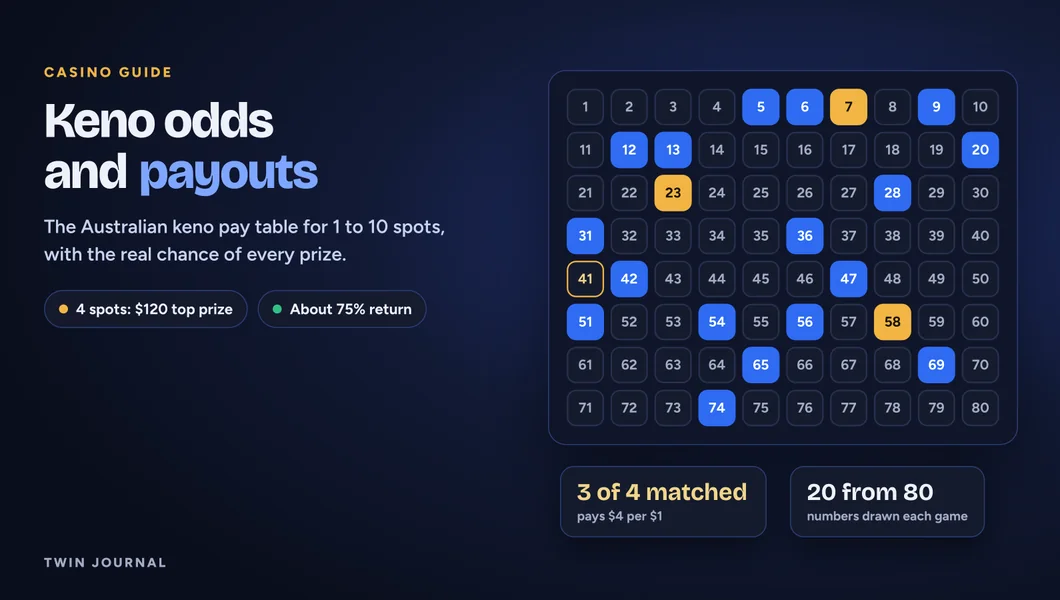
In Australian Keno, 20 numbers are drawn from 80 every few minutes, and you win by matching the numbers you picked (your “spots”). A $1 Keno Classic bet on 4 spots pays $120 for 4 matches, $4 for 3 and $1 for 2. A 10-spot ticket’s top prize is a jackpot of at least $1 million, but the chance is about 1 in 8.9 million. Over time, 1 to 6 spot games return about 75% of what’s bet, so the average loss is about 25 cents per dollar.
What you'll learn
- How a Keno Classic game works
- The full Australian keno payout chart for 1 to 10 spots
- The exact odds of every prize, and the return for each spot
- How Heads or Tails and Keno Bonus pay
- Why there are no best keno numbers
Keno is in pubs and clubs across Australia and in the Keno app, and it’s easy to play: pick some numbers, watch the draw, check your matches. What’s less obvious is how the prizes compare with the real chances of winning them. This guide puts the prize table and the odds side by side, so you can see what each ticket actually offers before you play.
How Keno works in Australia
| Feature | How it works |
|---|---|
| The draw | 20 numbers are drawn at random from 1 to 80 |
| How often | A new game about every 3 minutes, so roughly 20 games an hour |
| Your ticket | Pick from 1 to 10 numbers (spots) for Keno Classic. Some venues also offer 15, 20 and 40 spot games |
| Minimum bet | $1 per game for Keno Classic |
| How you win | Match enough of your numbers to the 20 drawn. More spots means bigger prizes but you need more matches |
| Who runs it | Keno (keno.com.au) is run by The Lottery Corporation in every state and territory except Western Australia |
Keno payout chart for Australia (Keno Classic, per $1)
This is the Keno Classic prize table per $1, as published in the Keno game guide. If you bet $5, multiply each prize by 5. The 7 to 10 spot top prizes are jackpots: the amount shown is where the jackpot starts, and it grows until someone wins it.
| Spots | Matches and prize per $1 |
|---|---|
| 1 spot | 1 match: $3 |
| 2 spots | 2 matches: $12 |
| 3 spots | 3: $44 · 2: $1 |
| 4 spots | 4: $120 · 3: $4 · 2: $1 |
| 5 spots | 5: $640 · 4: $14 · 3: $2 |
| 6 spots | 6: $1,800 · 5: $80 · 4: $5 · 3: $1 |
| 7 spots | 7: $5,000+ jackpot · 6: $125 · 5: $12 · 4: $3 · 3: $1 |
| 8 spots | 8: $25,000+ jackpot · 7: $675 · 6: $60 · 5: $7 · 4: $2 |
| 9 spots | 9: $100,000+ jackpot · 8: $2,500 · 7: $210 · 6: $20 · 5: $5 · 4: $1 |
| 10 spots | 10: $1,000,000+ jackpot · 9: $10,000 · 8: $580 · 7: $50 · 6: $6 · 5: $2 · 4: $1 |
Prizes can be reduced (abated) if a single game produces unusually large total prizes, and jackpots are shared if more than one ticket wins. Prize tables are set by the operator and can change, so check the current table on the Keno screen, ticket or app before you play.
Keno odds: your real chance of each prize
Because 20 of the 80 numbers are drawn, each number you pick has a 1 in 4 chance of coming up. The chance of matching several numbers falls fast. These are the exact odds for each ticket, worked out from the 20-from-80 draw, with the long-run return based on the prize table above:
| Spots | Chance of the top prize | Chance of any prize | Long-run return |
|---|---|---|---|
| 1 | 1 in 4 | 1 in 4 | 75.0% |
| 2 | 1 in 16.6 | 1 in 16.6 | 72.2% |
| 3 | 1 in 72 | 1 in 6.6 | 74.9% |
| 4 | 1 in 326 | 1 in 3.9 | 75.3% |
| 5 | 1 in 1,551 | 1 in 10.3 | 75.0% |
| 6 | 1 in 7,753 | 1 in 6.2 | 75.2% |
| 7 | 1 in 40,979 | 1 in 4.2 | 64.9%* |
| 8 | 1 in 230,115 | 1 in 9.8 | 65.0%* |
| 9 | 1 in 1,380,688 | 1 in 6.5 | 67.0%* |
| 10 | 1 in 8,911,711 | 1 in 4.7 | 65.2%* |
*For 7 to 10 spots, the return is calculated with the jackpot at its starting amount. A larger jackpot lifts the return slightly, but even a 10-spot jackpot of $2 million only adds about 11 cents per $1 bet. The “chance of any prize” includes small prizes that just return your $1, so on a 4-spot ticket many of your wins will be $1 back.
Worked example: an hour of 4-spot keno
You play a 4-spot ticket for $2 a game. Games run about every 3 minutes, so an hour is about 20 games and $40 spent. The long-run return for 4 spots is 75.3%, so on average you’d get back about $30 and lose about $10 an hour. In a real hour you might hit 3 of 4 once ($8) and 2 of 4 a few times ($2 each) and lose more, or catch 4 of 4 for $240. The average only shows up over many hours, and it always favours the operator.
Try the keno odds and payout calculator
Choose how many numbers you’ll pick, your bet per game and how many games you plan to play. The calculator shows the exact chance of every result, what each one pays for your bet, and the average loss the maths predicts for that session.
Free tool
Keno odds and payout calculator
| Numbers matched | Chance | Prize per $1 | Your prize |
|---|
Heads or Tails: keno's 50/50-looking bet
Heads or Tails is a separate keno bet on which half of the board gets more of the 20 numbers. Numbers 1 to 40 are “heads” and 41 to 80 are “tails”. You bet on Heads, Tails or Evens (a 10-10 split).
| Bet | Wins when | Pays per $1 | Chance | Long-run return |
|---|---|---|---|---|
| Heads | 11 or more numbers drawn from 1 to 40 | $2 | 39.8% (about 1 in 2.5) | 79.7% |
| Tails | 11 or more numbers drawn from 41 to 80 | $2 | 39.8% (about 1 in 2.5) | 79.7% |
| Evens | Exactly 10 from each half | $4 | 20.3% (about 1 in 4.9) | 81.3% |
Heads and Tails look like a coin toss, but they aren’t: the 10-10 split comes up about one game in five, and when it does, both Heads and Tails lose. That’s where the house edge comes from.
What is Keno Bonus?
Keno Bonus is an add-on for Keno Classic. It doubles the cost of your game. In return, if a bonus multiplier (x2, x3, x4, x5 or x10) is drawn for that game, your Keno Classic prizes are multiplied by it. If no multiplier comes up, the extra half of your stake is lost. Keno Bonus also adds a separate bonus amount to the 7 to 10 spot jackpots. Since it doubles the cost, it doubles how quickly you spend: a $1 game becomes $2.
Are there best keno numbers or combinations?
No. Searches for the “best keno numbers combinations” are common, but every number from 1 to 80 has exactly the same 1 in 4 chance of being drawn in every game, and each draw is independent of the last. Hot and cold numbers describe the past, not the future. Picking 7, 14 and 21 is no more or less likely to win than 1, 2 and 3.
| Common belief | The reality |
|---|---|
| “Hot” numbers keep coming up | Every number has the same 25% chance each game, whatever happened before |
| “Cold” numbers are due | The draw has no memory, so no number is ever due |
| Spreading numbers across the board helps | Every set of numbers of the same size has exactly the same chance |
| Playing the same numbers every game improves your odds | It doesn’t. It only means you’ll be playing them when they come up, which is equally likely for any numbers |
| More spots means better value | 1 to 6 spots return about 75%. 7 to 10 spots return about 65% at the starting jackpot |
What you can choose is the type of ticket. Fewer spots give smaller prizes more often. More spots give the chance of a big jackpot, but you’ll lose more on average. The same idea applies to other games: see how RTP and volatility work on pokies and why a single zero matters in roulette.
Keno compared with other games
| Game | Typical long-run return | Average loss per $100 bet |
|---|---|---|
| Keno Classic, 1 to 6 spots | About 75% | About $25 |
| Keno Classic, 7 to 10 spots | About 65% at the starting jackpot | About $35 |
| Keno Heads or Tails | About 80% | About $20 |
| European roulette | 97.3% | About $2.70 |
| Blackjack with basic strategy | About 99%, depending on the rules | About $0.50 to $1 |
Keno’s appeal is the small cost and the big top prizes, not the return. Because games run every few minutes, the cost adds up quickly. Decide how much you’ll spend before you start and stop when it’s gone. Our guide to setting gambling limits has practical ways to do that, and you can learn blackjack basic strategy if you prefer a game with a lower house edge.
Comparing keno with the lotteries? Our lotto odds guide sets out the odds of every division of Powerball, Oz Lotto, Saturday Lotto and Set for Life, with a free odds calculator.
Sources
- Keno (keno.com.au): official game guides and rules
- NSW Keno Rules (PDF)
- The Lottery Corporation
- Gambling Help Online
Prize table from the Keno game guide (NSW). Odds and returns calculated by TWIN Journal from the 20-from-80 draw. Checked 11 November 2026.
Frequently asked questions
What does keno pay in Australia?
In Keno Classic, prizes depend on how many numbers you pick and match. For $1, a 4-spot ticket pays $120 for 4 matches, a 6-spot pays $1,800 for 6, and a 10-spot top prize is a jackpot starting at $1 million.
What are the odds of winning keno?
It depends on your spots. A 4-spot ticket wins some prize about 1 in 3.9 games, but all 4 numbers come up only about 1 in 326 games. Matching all 10 on a 10-spot ticket is about 1 in 8.9 million.
How many numbers should I pick in keno?
No number of spots beats the house edge. 1 to 6 spots return about 75% over time, while 7 to 10 spots return about 65% at the starting jackpot, in exchange for a bigger top prize.
What are the best keno numbers?
There are none. Every number from 1 to 80 has the same 1 in 4 chance of being drawn each game, and past draws don’t affect future ones.
How does Heads or Tails work in keno?
You bet on which half of the board (1 to 40 or 41 to 80) gets more of the 20 numbers drawn. Heads or Tails pays $2 per $1, and Evens (a 10-10 split) pays $4.
Is Keno Bonus worth it?
Keno Bonus doubles the cost of each game for a chance at a prize multiplier. It doesn’t change your chance of matching numbers, and it doubles how fast you spend.
How often is keno drawn?
A new Keno game is drawn about every 3 minutes, which is roughly 20 games an hour.
Explore Casino Games on TWIN
Browse the casino games on TWIN. 18+ only, terms apply.
Gambling involves risk and outcomes are never guaranteed. Only play with money you can afford to lose. Free, confidential support is available 24/7 from Gambling Help Online on 1800 858 858.