Quick answer
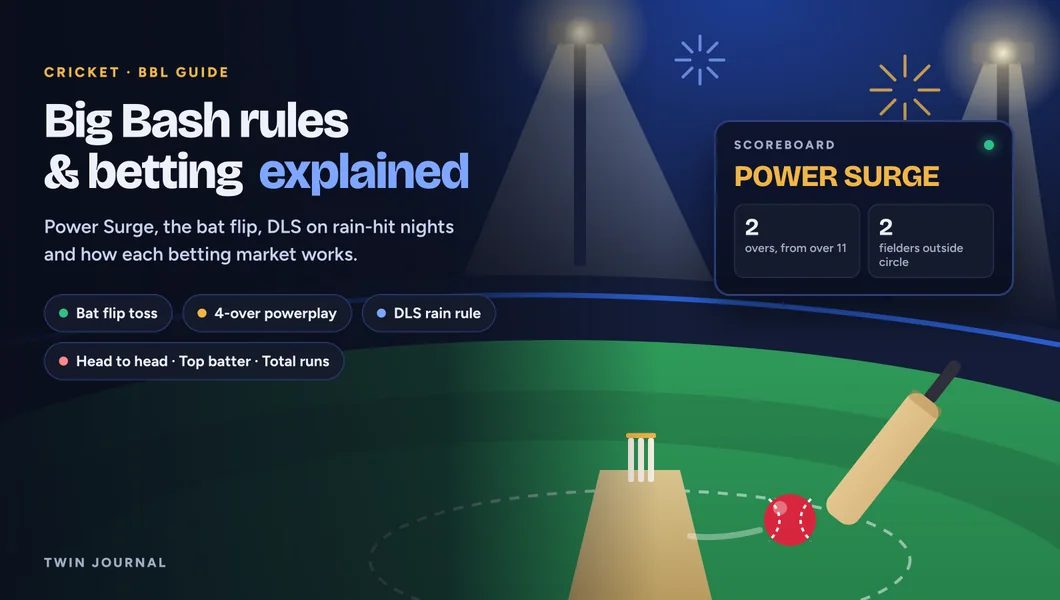
The Big Bash League (BBL) is Australia’s men’s T20 competition: eight teams, 20 overs a side, played from mid-December to late January. It has a few rules you won’t see in other cricket: a bat flip instead of a coin toss, a four-over powerplay, and a two-over Power Surge the batting side can call from the 11th over. Rain-shortened games are decided with the DLS method. The most popular bets are head to head, top batter and total match runs.
What you'll learn
- How a BBL season and finals series work
- The Power Surge, powerplay and bat flip rules
- How DLS decides rain-affected matches
- Every common BBL betting market, with worked examples
- How rain, ties and no results affect your bets
The Big Bash is the most-watched domestic cricket in Australia, and it plays by its own rulebook. If you’ve watched a game and wondered why the batting side suddenly asked for a “surge”, or why a team that scored fewer runs was declared the winner after rain, this guide explains it. It then walks through how BBL betting markets work, so you know exactly what you’re backing before you put money on a game.
How the BBL works: teams, season and finals
Eight city-based teams play in the BBL: the Adelaide Strikers, Brisbane Heat, Hobart Hurricanes, Melbourne Renegades, Melbourne Stars, Perth Scorchers, Sydney Sixers and Sydney Thunder. Each team plays 10 regular-season matches, five at home and five away. That’s 40 regular-season games, followed by four finals.
| Stage | Who plays | What’s at stake |
|---|---|---|
| Regular season | All 8 teams, 10 games each | Top 4 on the ladder reach the finals |
| The Qualifier | 1st v 2nd | Winner goes straight to the Final. Loser gets a second chance in the Challenger |
| The Knockout | 3rd v 4th | Winner goes to the Challenger. Loser is out |
| The Challenger | Qualifier loser v Knockout winner | Winner goes to the Final |
| The Final | Qualifier winner v Challenger winner | Played at the home ground of the Qualifier winner |
Finishing in the top two matters: those teams get a “double chance”, because losing the Qualifier doesn’t knock them out. In BBL|15 (2025–26), the Perth Scorchers beat the Sydney Sixers by six wickets in the Final on 25 January 2026 to win their sixth title. BBL|16 runs from mid-December 2026 to late January 2027; check the official fixture on bigbash.com.au for exact dates and start times.
Big Bash rules that differ from normal cricket
BBL games follow standard T20 cricket laws, with a handful of rules added to speed up play and create big moments. These are the ones that matter most when you’re watching or betting:
| Rule | What happens | Why it matters |
|---|---|---|
| Bat flip | The home captain flips a bat instead of a coin. The away captain calls “hills” (the back of the bat) or “flats” (the face) | The winner chooses to bat or bowl first, just like a coin toss |
| Opening powerplay | Overs 1 to 4 only. Just 2 fielders may stand outside the 30-yard circle | Shorter than the usual six-over T20 powerplay, so fast starts are harder to sustain |
| Power Surge | A 2-over powerplay the batting side can call from the 11th over. Only 2 fielders outside the circle | Often produces the biggest-scoring overs of the innings |
| Timed batters | An incoming batter must be ready to face within a set time (75 seconds) | Keeps the game moving after a wicket |
| DRS | Teams can review umpiring decisions | Close lbw and caught-behind calls can be overturned |
How the Power Surge works
The Power Surge is the BBL’s signature rule. The first four overs of each innings are a normal powerplay. The batting team then “banks” the remaining two powerplay overs and can call them at the start of any over from the 11th over onwards. During those two overs, the fielding side can only have two fielders outside the circle, so boundaries are easier to find.
Teams use it differently. A side with set batters will often call it around overs 13 to 16 to accelerate. A side that has lost early wickets may hold it until the death overs. For viewers and punters, the Power Surge is a reminder that BBL scoring often spikes in the second half of an innings, which can move live total-runs markets sharply.
Bash Boost and X-Factor
In 2020–21, the BBL also brought in the Bash Boost (a bonus ladder point for the team ahead at the 10-over mark) and X-Factor substitutes (a 12th or 13th player who could replace a player after the 10th over of the first innings). Rules like these are reviewed most seasons, so check the BBL|16 playing conditions before relying on them, especially if you’re following the ladder.
Rain and the DLS method
Summer storms interrupt plenty of BBL games. When overs are lost, the match is decided with the Duckworth-Lewis-Stern (DLS) method. DLS doesn’t simply compare run rates. It treats each team as having two “resources” to score with: overs remaining and wickets in hand. If a team loses overs, its target is adjusted based on how much of those combined resources it actually had.
| Situation | What usually happens |
|---|---|
| Rain before the chase starts, overs reduced | The chasing team gets a revised (usually lower) target from fewer overs |
| Rain during the chase, play resumes | The target is recalculated for the remaining overs |
| Rain ends the game after both teams have batted at least 5 overs | The team ahead of the DLS “par score” wins |
| Fewer than 5 overs possible for the team batting second | No result. Each team gets a share of the points |
| Scores level at the end | A Super Over decides the winner |
Worked example: why wickets matter in DLS
Two teams are chasing 170 when rain stops play after 10 overs. Team A is 80 for 1. Team B is 80 for 5. They have the same run rate, but Team A has used far fewer of its resources because it still has nine wickets in hand. That’s why Team A would be well ahead of the DLS par score, while Team B would probably be behind it. Keeping wickets in hand is worth a lot when rain is around.
BBL betting markets explained
Most Australian bookmakers offer the same core markets on every BBL game. Here’s what each one means and how it’s settled:
| Market | What you’re backing | Example |
|---|---|---|
| Head to head (match winner) | Which team wins, including a Super Over if needed | Scorchers $1.80, Sixers $2.00 |
| Line (handicap) | A team to win after a runs adjustment | Sixers +8.5 runs: they can lose by up to 8 runs and your bet still wins |
| Total match runs | Whether both innings combined go over or under a set number | Over 320.5 runs |
| Top team batter | Which player scores the most runs for their side | Usually $4 to $8 for top-order batters |
| Top team bowler | Which player takes the most wickets for their side | Ties on wickets are usually split as a dead heat |
| Most sixes | Which team hits more sixes | A popular BBL novelty market |
| First innings runs | Total runs scored by the team batting first | Over 165.5 runs |
| Tournament winner (futures) | Which team wins the BBL Final | Placed before or during the season |
Reading head-to-head odds
Australian odds are decimal: the number shows what you get back for each $1, including your stake. A $10 bet at $1.80 returns $18.00 (an $8.00 profit). Odds also tell you the chance the bookmaker is implying: divide 1 by the odds. At $1.80 that’s 55.6%, and at $2.00 it’s 50%. Add them together and you get 105.6%, not 100%. The extra 5.6% is the bookmaker’s margin. Our guide to how betting odds work explains this in more detail.
Head-to-head odds checker
Enter the odds for both teams to see the implied chance of each side winning, the bookmaker’s margin, and what your stake would return.
Free tool
Head-to-head odds checker
| Team | Implied chance | Fair chance (margin removed) | Return on stake |
|---|
Implied chance is 1 ÷ odds. The "fair" chance spreads the bookmaker's margin out so both sides add up to 100%. These are estimates, not predictions.
How rain, ties and no results affect your bets
Settlement rules vary between bookmakers, so always read the cricket rules on the site you use. These are the most common approaches in Australia:
| What happens in the game | Head to head | Total runs and player markets |
|---|---|---|
| Result decided by DLS | Usually stands, settled on the official result | Often void if the overs were reduced after you bet, because the line was set for 40 overs |
| No result (washout) | Usually void, and your stake is refunded | Usually void unless the result was already decided |
| Tie decided by a Super Over | Usually settled on the Super Over winner | Super Over runs normally don’t count towards totals |
| Player doesn’t bat or bowl | Not affected | Top batter or bowler bets on that player may be void or lose, depending on the provider’s rules |
Betting during the game
Under the Interactive Gambling Act, licensed Australian bookmakers can’t take in-play bets online once a match has started. Live betting is available by phone. Our in-play betting guide explains the rules.
Things to check before betting on a BBL game
| Check | Why it matters |
|---|---|
| The final XI | Teams are named close to the start. International call-ups often change BBL line-ups mid-season |
| The venue and pitch | Grounds differ in size and pace. Short boundaries suit sixes and higher totals |
| The weather | Rain brings DLS into play and can void totals and player markets |
| Day or night game | Dew later in the evening can make bowling harder for the side defending a total |
| The ladder | Late in the season, some teams are fighting for a finals spot and others have nothing to play for |
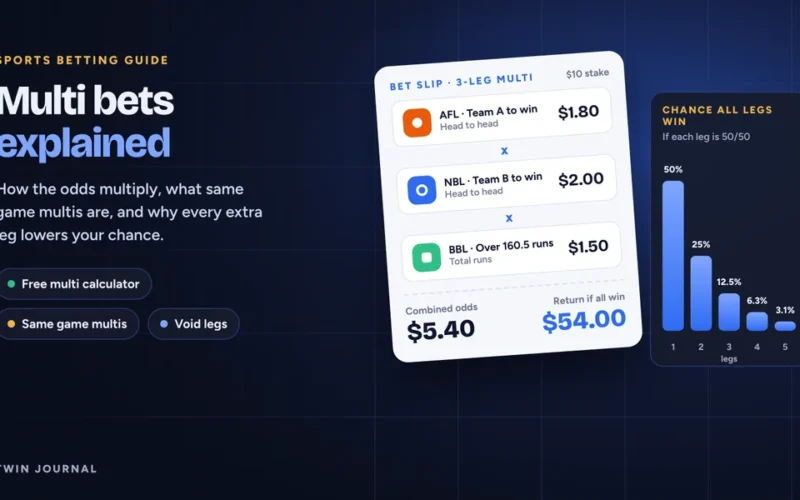
Many people combine several BBL picks into one bet. If you’re thinking about it, read our guide to multi bets and same game multis first, because every extra leg lowers your chance of winning. Set a budget for the summer before the season starts. Our guide to setting deposit limits explains the tools available, and if betting stops being fun, BetStop lets you block yourself from every licensed provider in one step.
Sources
Frequently asked questions
What is the Power Surge in the Big Bash?
The Power Surge is a two-over powerplay the batting team can call at the start of any over from the 11th over. During it, only two fielders can be outside the 30-yard circle, which makes boundaries easier to hit.
How long is the powerplay in the BBL?
The opening powerplay is four overs, shorter than the usual six in T20 cricket. The other two powerplay overs become the Power Surge, which the batting side chooses when to use.
How many teams make the BBL finals?
The top four teams on the ladder. First plays second in the Qualifier, third plays fourth in the Knockout, then the Challenger decides who joins the Qualifier winner in the Final.
How does DLS work in the Big Bash?
When rain reduces a match, the Duckworth-Lewis-Stern method adjusts the target based on the overs and wickets each team had available. Both teams need to have faced at least five overs for a result.
What happens to my bet if a BBL game is washed out?
With most Australian bookmakers, head-to-head bets are void and stakes refunded if there’s no result. Check your provider’s cricket rules, because they can differ.
Why does the BBL use a bat flip instead of a coin toss?
It’s a BBL tradition that started in 2018–19. The home captain flips a bat and the away captain calls hills or flats. The winner chooses to bat or bowl first.
Explore Cricket and Sports
See current cricket and sports markets on TWIN. 18+ only, terms apply.
Gambling involves risk and outcomes are never guaranteed. Only play with money you can afford to lose. Free, confidential support is available 24/7 from Gambling Help Online on 1800 858 858.