Quick answer
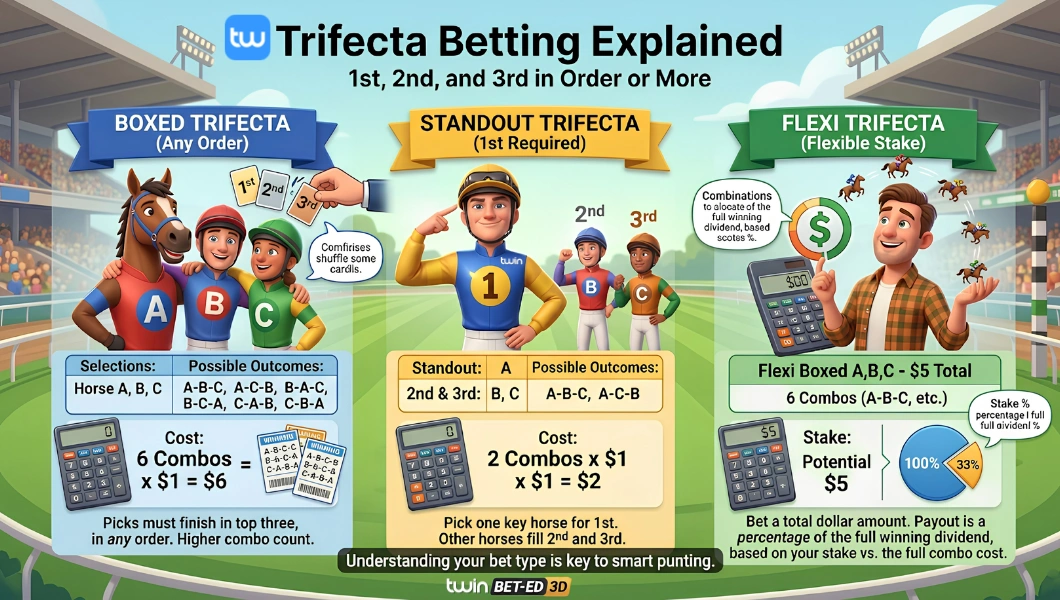
A trifecta is a bet on which runners finish first, second and third. A standard trifecta needs the exact order. A boxed trifecta pays in any order but costs more, because every possible order is a separate combination. A 4-horse box is 24 combinations, so $24 buys 100% of each combination, and $12 buys 50% as a flexi bet.
What you'll learn
- What a trifecta is and how its dividend is paid
- Boxed, standout, roving banker and flexi trifectas
- How to cost any trifecta or quaddie with the calculator
- Melbourne Cup examples, scratchings and the real odds
The trifecta is one of the most popular exotic bets in Australian racing, especially on big days like the Melbourne Cup. One correct trifecta can return hundreds of dollars from a small outlay. That potential comes from how hard it is to pick three placegetters in the right order, so the cost of covering more outcomes climbs quickly.
This guide explains each type of trifecta, shows you how to work out the cost of any combination, and gives worked examples you can check in the calculator.
What is a trifecta?
A trifecta (sometimes called a “tri”) is a bet on the first three runners home in a race, in the exact order. If you take 4-7-2, number 4 must win, 7 must run second and 2 must run third.
Trifectas are usually tote bets. Everyone’s stakes go into a pool, the operator takes its commission, and the rest is shared among the winning tickets. The dividend is declared per $1 unit after the race. Because few people pick the exact order, trifecta dividends are much bigger than win or place dividends, but they’re also impossible to know in advance.
Trifecta types at a glance
| Type | What you pick | Combinations | Example |
|---|---|---|---|
| Straight | One runner each for 1st, 2nd and 3rd | 1 | 4-7-2 in that order |
| Boxed | A group of runners to fill the top three in any order | n × (n−1) × (n−2) | Box 2, 4, 7 = 6 combinations |
| Standout | One runner to win, others to fill 2nd and 3rd | k × (k−1), where k is the number of others | 4 / 1, 6, 8, 11 = 12 combinations |
| Roving banker | One runner anywhere in the top three, plus others | 3 × k × (k−1) | 4 anywhere with 1, 6, 8 = 18 combinations |
| Field | Your selections plus every runner in a position | Depends on field size | 4 to win, then any two in the field |
| Custom (multiple legs) | Different runners for each position | Count of valid orders | 1st: 4, 7 · 2nd: 2, 4, 7 · 3rd: any of five |
How many combinations is a boxed trifecta?
A boxed trifecta covers every order of the runners you choose. The number of combinations grows quickly as you add runners:
| Runners in the box | Combinations | Cost at 100% | Flexi % for a $20 budget |
|---|---|---|---|
| 3 | 6 | $6 | 333% |
| 4 | 24 | $24 | 83.3% |
| 5 | 60 | $60 | 33.3% |
| 6 | 120 | $120 | 16.7% |
| 7 | 210 | $210 | 9.5% |
| 8 | 336 | $336 | 6.0% |
Every extra runner adds a lot more combinations, and spreading your money across them means a smaller share of the dividend if you win. The art of trifecta betting is choosing how much to cover.
Flexi betting explained
A flexi bet lets you choose your total outlay instead of paying $1 for each combination. Your stake is spread across every combination, and you get that percentage of the declared dividend.
Flexi % = total outlay ÷ number of combinations × 100
Worked example
You box five runners (60 combinations) for a total of $30. Your flexi percentage is $30 ÷ 60 × 100 = 50%. The trifecta comes in and pays $412.70 per $1. You collect 50% of that: $206.35.
Providers set minimum flexi percentages and minimum stakes, so check those before you place a large box for a small outlay.
Trifecta and quaddie calculator
Choose a bet type, enter your selections and your outlay, and the calculator shows the number of combinations, your flexi percentage and an estimated return for a dividend you enter.
Free calculator
Trifecta and quaddie calculator
Standout and roving banker trifectas
If you’re confident about one runner, a standout or roving banker is cheaper than a big box.
- Standout: you think number 4 will win, and any two of 1, 6, 8 and 11 will fill the minor places. That’s 4 others × 3 = 12 combinations, or $12 at 100%. The same five runners in a box would cost $60.
- Roving banker: you think number 4 will run in the top three but you’re not sure where. With 1, 6 and 8 as the others, that’s 3 positions × 3 × 2 = 18 combinations.
- Standout for second: some punters think a favourite will run second, so they stand it out in second place instead.
A Melbourne Cup trifecta example
The Melbourne Cup has up to 24 starters, which makes the trifecta harder to land than in a small field. Here are four ways to spend $36 on the same race. The runner numbers are made up for illustration:
| Strategy | Selections | Combinations | Flexi % for $36 |
|---|---|---|---|
| 4-runner box | 3, 8, 12, 17 | 24 | 150% |
| 5-runner box | 3, 8, 12, 17, 21 | 60 | 60% |
| Standout | 8 to win / 3, 12, 17, 21, 5 | 20 | 180% |
| Roving banker | 8 anywhere / 3, 12, 17, 21 | 36 | 100% |
None of these is “best”. The bigger box wins more often but pays a smaller share. The standout pays more when it hits but loses if 8 doesn’t win. Decide which risk you’re comfortable with before you bet.
Scratchings and dead heats
- Scratchings: if a runner in your trifecta is scratched, the combinations that include it are generally refunded. The rest of your bet stands. Check your provider’s rules, because they can differ.
- Dead heats: if two runners dead-heat for a placing, each matching combination wins. The pool is shared between more winning tickets, so the dividend for each is smaller.
- Small fields: if fewer than three runners finish, the operator’s rules decide how the trifecta is paid.
Trifecta vs other exotic bets
| Bet | What you need to pick | Difficulty |
|---|---|---|
| Quinella | The first two runners, in any order | Easier |
| Exacta | The first two runners, in the exact order | Moderate |
| Duet | Any two of the first three runners, in any order | Easier |
| Trifecta | The first three runners, in the exact order | Hard |
| First Four | The first four runners, in the exact order | Very hard |
| Quaddie | The winners of four nominated races | Very hard |
How a quaddie works
A quaddie (quadrella) asks you to pick the winner of four nominated races, usually the last four on a card. You can pick more than one runner in each leg. The combinations are the selections in each leg multiplied together.
Quaddie example
You pick 2 runners in leg 1, 3 in leg 2, 2 in leg 3 and 4 in leg 4. That’s 2 × 3 × 2 × 4 = 48 combinations. A $24 outlay is a 50% flexi bet. If a runner in your quaddie is scratched, it’s usually replaced by the favourite in that leg. Check your provider’s rules.
Why trifectas are hard to win
Trifectas pay well because they’re unlikely. In a 10-runner race there are 10 × 9 × 8 = 720 possible orders for the first three. A 4-runner box covers 24 of them, which is 3.3% of the outcomes if every order were equally likely. In a full 24-runner Melbourne Cup there are 12,144 possible orders.
The tote also deducts commission from the pool before paying dividends, so the bettors as a group always get back less than they put in. Treat trifectas as entertainment with a small budget, not a way to make money. If you’d like to set a limit before race day, our guide to setting deposit limits and taking breaks shows how.
Related guides
- Each way bets explained: the other bet most people place on the Cup
- Melbourne Cup sweep: free template and generator
- How betting odds work: implied probability and bookmaker margins
Sources
Frequently asked questions
What does trifecta mean in betting?
A trifecta is a bet on the first three finishers in a race in the exact order. You can also box your runners so they can finish in any order, which costs more.
What is a boxed trifecta?
A boxed trifecta covers every order of the runners you choose. Three runners is 6 combinations, four runners is 24 and five runners is 60.
How much does a 4-horse boxed trifecta cost?
A 4-horse box is 24 combinations, so it costs $24 at 100%. You can also take it as a flexi bet. For example, $12 is a 50% flexi bet and returns half the dividend.
What is a flexi trifecta?
A flexi trifecta lets you choose your total outlay. Your flexi percentage is the outlay divided by the number of combinations, and you get that percentage of the dividend.
What happens if a horse in my trifecta is scratched?
Combinations that include the scratched runner are generally refunded and the rest of the bet stands. Check your provider’s rules.
How do you work out quaddie combinations?
Multiply the number of runners you selected in each of the four legs. For example, 2 × 3 × 2 × 4 = 48 combinations.
Explore Racing and Sports
See current racing and sports markets on TWIN. 18+ only, terms apply.
Gambling involves risk and outcomes are never guaranteed. Only play with money you can afford to lose. Free, confidential support is available 24/7 from Gambling Help Online on 1800 858 858.