Quick answer
A Melbourne Cup sweep is a simple office or family game: everyone pays the same small amount, each person draws a horse at random, and the pool is shared among the people who drew the placegetters. Use the free generator below to draw names in seconds, or print the blank template and draw from a hat. The 2026 Melbourne Cup is run on Tuesday 3 November at Flemington, at about 3pm AEDT.
What you'll learn
- How a sweep works and what to charge
- How to draw names instantly with the free generator
- Printable template and prize-split examples
- What to do about scratchings, emergencies and dead heats
Every November, offices, pubs and family lounge rooms across Australia stop for about three minutes to watch the Melbourne Cup. A sweep is the easiest way to give everyone a horse to cheer for, whether or not they follow racing. It takes about ten minutes to organise if you decide the rules before the draw, and most arguments on the day come from rules nobody agreed in advance.
This guide covers everything you need: the key 2026 dates, a free sweep generator, a printable template, how much to charge, how to split the prize pool, and simple rules for scratchings and dead heats.
Melbourne Cup 2026 at a glance
| Detail | 2026 Melbourne Cup |
|---|---|
| Date | Tuesday 3 November 2026 |
| Venue | Flemington Racecourse, Melbourne |
| Start time | About 3:00pm AEDT (race 7 on the Flemington card) |
| Distance | 3200 metres |
| Field size | Up to 24 starters, plus emergencies |
| Final field and barriers | Confirmed after the last race on Derby Day, Saturday 31 October |
| Public holiday | Metropolitan Melbourne (some regional Victorian councils swap it for a local show day) |
Start times in other states: about 3:00pm in Sydney, Canberra and Hobart, 2:30pm in Adelaide, 2:00pm in Brisbane, 1:30pm in Darwin and 12:00pm in Perth.
How a Melbourne Cup sweep works
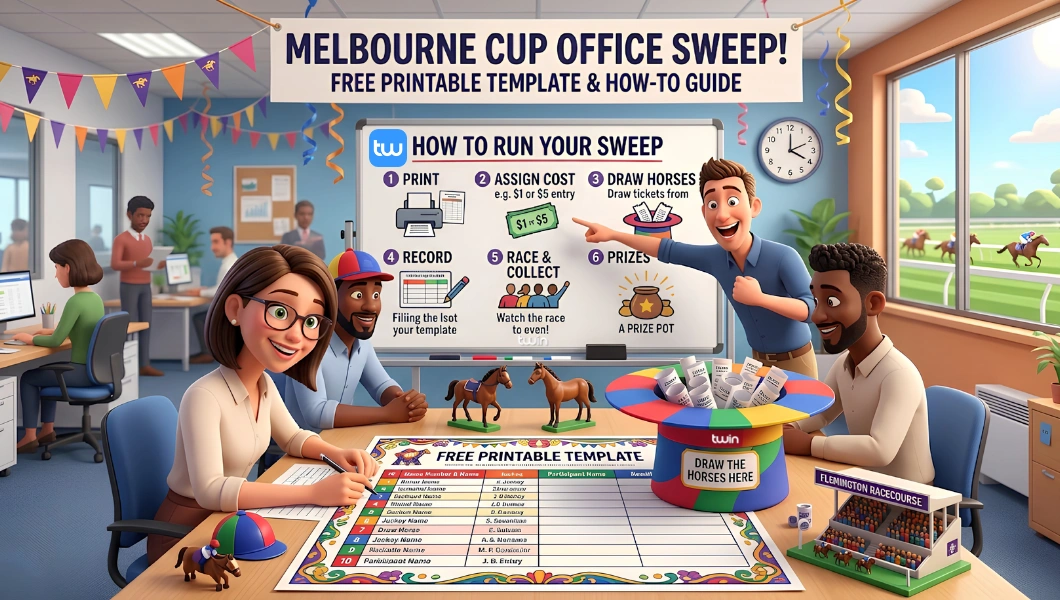
- Set the price. Everyone pays the same amount per ticket, usually $2 to $10.
- Collect names. Write down every person (or every ticket, if someone buys more than one).
- Draw the horses. Match each name to a horse at random, using the generator below or numbered slips in a hat.
- Agree the prizes. Decide before the draw how the pool will be split, for example 1st, 2nd, 3rd and last.
- Watch and pay out. After the race, pay the people holding the placegetters. That’s it.
Sweeps usually use saddlecloth numbers: the large number on each horse’s saddlecloth, from 1 to 24. Number 1 carries the most weight. These numbers are confirmed when the field is final, so you can run the draw with numbers first and fill in horse names on Saturday night.
Free Melbourne Cup sweep generator
Add one name per line, choose the number of horses and the ticket price, and press Draw sweep. The generator shuffles the names using your browser’s random number generator, assigns every horse, and works out the prize pool. Nothing is saved or sent anywhere.
Free tool
Melbourne Cup sweep generator
| No. | Drawn by | Horse name |
|---|
Who owes what
| Name | Horses | Pays |
|---|
Draw made in your browser with a cryptographically secure shuffle. Nothing is saved or sent. Fill in horse names once the final field is announced on Saturday 31 October.
If you have fewer people than horses, the generator gives some people two horses. The table shows exactly who holds which horse, so print it or screenshot it straight away.
Printable Melbourne Cup sweep template
Prefer a paper sweep? Use the Print blank template button in the generator. You get a one-page A4 sheet with 24 rows and these columns:
| Column | What to write |
|---|---|
| No. | Saddlecloth number (1 to 24) |
| Horse | Horse name, once the final field is announced on Saturday 31 October |
| Barrier | The starting gate (optional, but fun to track) |
| Name | The person who drew this horse |
| Paid | Tick when the ticket is paid |
| Result | 1st, 2nd, 3rd or last |
How to run a paper draw: write 1 to 24 on small slips, fold them and put them in a hat or envelope. Each person draws a slip and writes their name next to that number on the sheet.
How much to charge and how to split the prize pool
Choose a price that nobody minds losing. A sweep is meant to be social, not a way to win big. With a full field of 24 tickets:
| Ticket price | Prize pool (24 tickets) |
|---|---|
| $2 | $48 |
| $5 | $120 |
| $10 | $240 |
| $20 | $480 |
Then pick a prize split and announce it before the draw:
| Split | 1st | 2nd | 3rd | Last | Best for |
|---|---|---|---|---|---|
| Winner takes all | 100% | – | – | – | Small groups and quick sweeps |
| Top three | 60% | 25% | 15% | – | The classic office sweep |
| Top three plus last | 60% | 25% | 10% | 5% | Bigger groups: more people win something |
Worked example
An office of 24 people pays $5 each, so the pool is $120. Using the “top three plus last” split, 1st receives $72, 2nd receives $30, 3rd receives $12 and the person who drew the last horse home gets $6 back, so they break even on a $5 ticket and still get a laugh.
Round the split to amounts that are easy to pay in cash or by bank transfer. If the pool doesn’t divide neatly, give the leftover dollars to first place.
More people than horses, or fewer?
There are only 24 starters, so offices rarely match the field exactly. Here are the common fixes:
| Situation | Simple options |
|---|---|
| Fewer people than horses (for example, 15 people) | Sell the spare tickets to anyone who wants a second horse, or let the generator give some people two horses |
| Exactly 24 people | One horse each: the classic sweep |
| More people than horses (for example, 40 people) | Run two separate sweeps, or sell half-tickets so two people share a horse and its prize |
| Very large groups | Use “pick a number” sweeps of 24 tickets each, run in parallel |
If some people get two horses, make sure everyone paid for every ticket they hold. Two horses means two tickets.
Scratchings, emergencies and dead heats
Agree these rules before the draw. They’re the most common cause of sweep disputes.
- Drawing before the final field: if you draw on Monday, the field is already final (it’s confirmed on Saturday 31 October). If you draw earlier, draw saddlecloth numbers and fill in the names later.
- Late scratchings: if a horse is scratched after your draw, pick one rule and stick to it. You can refund that ticket, or give the holder an emergency runner that takes its place. You can also redraw that ticket from any unallocated horses.
- Dead heats: if two horses tie for a place, split that place’s prize between the two ticket holders.
- “Last” prize: decide whether it goes to the last horse to cross the line, or whether a horse that doesn’t finish counts as last. Most sweeps use the last horse to finish.
- Protests and inquiries: pay out on the official result, not the order seen on screen. It can change after a protest.
Fun sweep ideas for the office
- Fashions on the Field mini-prize: a small side prize for the best hat, decided by a quick vote.
- Barrier bingo: a free extra game where people guess which barrier the winner jumped from.
- Charity sweep: everyone pays $5 and half the pool goes to a charity the office chooses.
- Two-horse sweep: each person draws two horses, so they have twice the chance to cheer.
- Calcutta: an auction-style sweep where people bid for horses. It involves much larger sums and works differently from a standard sweep, so keep the office sweep simple.
Keeping your sweep legal and friendly
Check the rules in your state
Rules on small private sweeps vary between states and territories. A friendly office sweep usually stays within the rules when everyone pays the same small amount, every dollar is returned as prizes, the organiser takes no cut, entry is voluntary and only adults take part. If you’re running a sweep for a business, club or charity fundraiser, check with your state or territory gaming regulator first, for example Liquor & Gaming NSW or the Victorian Gambling and Casino Control Commission.
Keep it inclusive, too. Not everyone gambles, and nobody should feel pressured to buy a ticket. Offer a free “guess the winner” alternative for anyone who wants to join in without paying.
Understanding the race card
A sweep only needs a number and a name, but knowing what’s on the race card makes the race more fun to follow:
| Term | What it means |
|---|---|
| Saddlecloth number | The horse’s number for the race, 1 to 24. Lower numbers carry more weight |
| Barrier | The starting stall the horse jumps from. Barrier 1 is closest to the inside rail |
| Weight | The weight the horse carries, set by the handicapper. A handicap race like the Cup gives better horses more weight |
| Emergencies | Reserve horses that run only if a horse in the main field is scratched |
| Form | A string of recent finishing positions, for example 1×32 (1st, a spell, 3rd, then 2nd) |
Want to bet on the Cup?
A sweep is the lowest-stakes way to enjoy the race. If you’d also like to understand the bets people place, our guides explain how a trifecta works and what each way means, and how betting odds work covers reading prices. Whatever you do, decide your budget first. Our guide to setting deposit limits and taking breaks shows how.
Sources
Frequently asked questions
When is the 2026 Melbourne Cup?
The 2026 Melbourne Cup is on Tuesday 3 November at Flemington Racecourse, with the race starting at about 3:00pm AEDT. The final field and barriers are confirmed on Saturday 31 October.
How does a Melbourne Cup sweep work?
Everyone pays the same amount for a ticket and is matched with a horse at random. After the race, the pool is paid to the people holding the placegetters, usually 1st, 2nd and 3rd, and sometimes the last horse.
How much should a Melbourne Cup sweep cost?
Most office sweeps cost $2 to $10 a ticket. With 24 tickets at $5, the prize pool is $120.
How do you split sweep winnings?
A common split is 60% to first, 25% to second and 15% to third. For bigger groups, try 60%, 25%, 10% and 5% for the last horse. Agree the split before the draw.
What happens if my sweep horse is scratched?
That depends on the rule your group agrees before the draw. The usual options are a refund, the emergency runner that replaces the scratched horse, or a redraw from unallocated horses.
Is an office Melbourne Cup sweep legal?
Rules vary by state and territory. A small sweep where everyone pays the same amount, all money is returned as prizes and the organiser takes no cut is the usual approach. Check with your state gaming regulator for fundraisers or larger sweeps.
Explore Racing and Sports
See current racing and sports markets on TWIN. 18+ only, terms apply.
Gambling involves risk and outcomes are never guaranteed. Only play with money you can afford to lose. Free, confidential support is available 24/7 from Gambling Help Online on 1800 858 858.